




25 Sep Nitrogen efficiency in reduced protein diets – Actisaf® Sc 47 secures performance and sustainability of dairy farming
O.MERDY, category manager
Reduced protein diets: balancing between performance, cost saving and sustainability
In dairy farming, the popularity of reduced protein diets has surged, driven by the dual pressures of rising feed costs and the need for greater sustainability. On one hand, due to the high and volatile cost of purchased protein feeds such as soybean meal, the protein component has significantly escalated and now could account for nearly 40% of the total ration expense, thus affecting heavily the financial figures of dairy farming. On the other side, only a low fraction of this expensive nutrient is effective at producing milk. More than two-thirds of nitrogen inputs are ultimately excreted in the environment via urine or faeces, not exported as milk protein or retained by the cow. Nitrogen being recognized as responsible for eutrophication of environments and contributing to climate change, dairy farming sustainability targets require to lower nitrogen outputs as well.
To reduce costs and reduce nitrogen excretion, cattle rations can be reformulated by fine-tuning the crude protein levels to align more closely with the animal nutritional demands and take advantage of the improvement of efficiency of nitrogen utilization with reduced dietary protein strategies. Safety margins may also be optimized with strategic use of relevant feed additives.
Yeast probiotic modulates protein digestibility
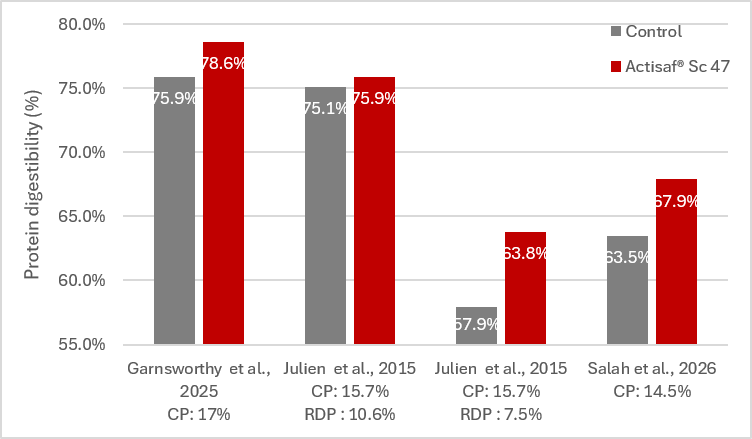
Actisaf® Sc 47 (Saccharomyces cerevisiae Sc 47, Phileo by Lesaffre) is recognized for its ability to stabilize the rumen environment by controlling the rumen redox potential. Therefore, a beneficial and more stable microbiota fermentative activity is promoted resulting in reduced risk of acidosis and enhanced fibre digestion. These key activities explain why the impact of a live yeast supplementation has been studied primarily on energetic metabolism in relation with the dietary forage: concentrates ratio. The consensus was that yeast probiotic supplementation is key to maintain rumen health and function when high concentrated diet is consumed or during an abrupt dietary transition. However, the impact of yeast probiotic supplementation on N metabolism is less studied. The study published by Julien and coll. (2015) on the effect of Actisaf® Sc 47 supplementation reported an increase of N total tof 0.8 point to 5.9 points in supplemented dairy cows fed 15.6% CP diet with respectively normal and reduced levels of rumen degradable proteins. Garnsworthy et al. recently reported a 2.7 points (75.9% to 78.2%) improvement of N total in high-yield dairy cows fed a 17% CP diet. Next to these digestibility results, Julien et al. also showed that the re-excretion in faeces could be greatly reduced. These positive results called for an extended evaluation of N metabolism to elucidate the possibility of increasing N efficiency particularly in low protein diet.
Reduced protein diet confirmed to increase N efficiency and reduce N excretion
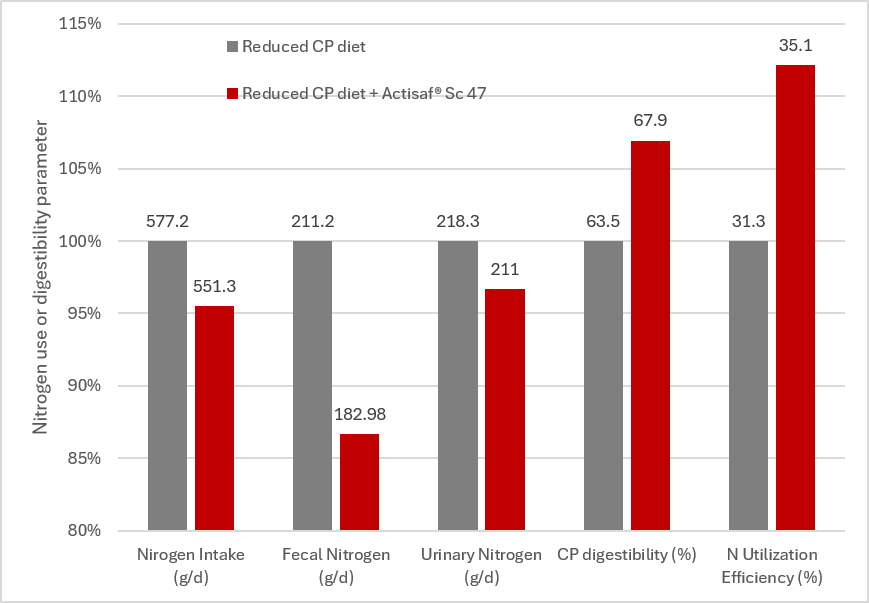
Such study was recently performed at Phileo experimental farm (Salah et al. 2026a, b). Next to this, N efficiency (N milk / N intake) was increased by 4.9 percentage points on average from 28.3 points in the high protein diet to 31.3 and 35.1 points in the reduced protein diets respectively unsupplemented and supplemented with the yeast probiotic.
Actisaf® Sc 47 positively impacts N metabolism in dairy cows fed low CP diets
Actisaf® Sc 47 supplementation did not affect N intake but resulted in a significant increase of N digestibility by 4.4 percentage points (63.5% vs 67.9%), together with a numerical increase in NDF digestibility by 4.1%. While the latter results recall the ability of the yeast probiotic to enhance fibre degradation by fibrolytic and cellulolytic bacteria, it could be hypothesized that the improved microbial metabolic activity also contributes to better CP digestibility.
Actisaf® Sc 47 supplementation also tended to reduce nitrogen faecal excretion by . Next to this, Nitrogen efficiency was increased by almost 4%, explained by an increased milk protein yield by 5.9% (p<0.) (Salah et al. 2026a,b). All these results plead for a definite improvement of N metabolism in cows supplemented with the reference yeast probiotic Actisaf® Sc 47, allowing dairy cows to make the best of reduced dietary protein diets, exporting more milk and decreasing N emissions.
Uncovering how live yeast improves nitrogen efficiency and reduces environmental footprint
The positive impact of the yeast probiotic Actisaf® Sc 47 on N metabolism could be explained by several mechanisms related to increased microbial protein availability for absorption and reduced ruminal ammonia nitrogen, which would decrease urinary N excretion:
- Increased microbial proteosynthesis: The probiotic yeast is well known for its ability to promote abundance and activity of cellulolytic & fibrolytic bacteria such as Fibrobacter, Ruminococcus and Eubacterium, that help to produce more energy for the dairy cow and the cow microbiota (Pinloche et al., 2013). It could be hypothesized that these bacteria also consume more NH4 in the rumen to build microbial proteins as observed in this study by a numerical increase of +4.4% (RMP) of rumen microbial protein.
- Decreased ruminal proteolysis: Prior research evidenced also the ability of live yeast to modulate the proliferation of ruminal proteolytic bacteria, such as Prevotella ruminicola (Chaucheyras et al., 2005) & Proteobacteria (Pinloche et al., 2013). A reduction by 5.2 points of dietary N ruminal degradation was also observed with Actisaf® Sc 47 by Julien et al. (2015). The decrease in the proportion and/or activity of proteolytic bacteria in presence of the yeast probiotic supports then nitrogen absorption in the hindgut.
- Reduced ruminal ammonia availability: Supplementation with Actisaf® Sc 47 has been associated with a numerical reduction in ruminal ammonia concentrations in dairy cows (Kumprechtova et al., 2019; Moallem et al., 2009). Given the dependence of urinary nitrogen excretion on ruminal ammonia levels, it is plausible that Actisaf® Sc 47 reduces urinary nitrogen output by helping decrease the nitrogen pool available for excretion.
Conclusion
The dairy industry faces the dual challenge of rising feed costs and increasing environmental pressures, driving the need for reduced-protein diet formulations. However, these diets come with additional emphasis on careful formulation of protein level and quality and as well as optimised safety margins balancing for potential drawbacks on animal performance. In the search for an optimal balance between performance, cost reduction and sustainability, considering the beneficial effects of the yeast probiotic Actisaf® Sc 47 on nitrogen utilization, rumen health, and energy metabolism appears to be a valuable insight for feed formulation. The research presented here provides valuable insights into how Actisaf® Sc 47 can help navigate the challenges of reduced-protein feeding and unlock the full potential of these diets.
References
Chaucheyras-Durand, F., et al. (2005). Effect of the Microbial Feed Additive Saccharomyces cerevisiae CNCM I-1077 on Protein and Peptide Degrading Activities of Rumen Bacteria Grown In Vitro. Curr Microbiol 50, 96–101
Garnsworthy, P. C. et al. (2025). Effects of live yeast on milk yield, feed efficiency, methane emissions and fertility of high-yielding dairy cows. animal, 19(1), 101379.
Julien, C. et al. (2015). Interaction between live yeast and dietary rumen degradable protein level: effects on diet utilization in early-lactating dairy cows. Agricultural Sciences, 6, 1-13
Kumprechtová, D. et al. (2019). Effect of live yeast (Saccharomyces cerevisiae) supplementation on rumen fermentation and metabolic profile of dairy cows in early lactation. Journal of animal physiology and animal nutrition, 103(2), 447-455.
Moallem, U. et al. (2009). The effects of live yeast supplementation to dairy cows during the hot season on production, feed efficiency, and digestibility. Journal of dairy science, 92(1), 343-351.
Pinloche, E. et al. (2013). The effects of a probiotic yeast on the bacterial diversity and population structure in the rumen of cattle. PloS one, 8(7), e67824.
Salah, N. et al. (2026a). Reducing Protein Content with and Without Yeast Probiotic Actisaf Sc 47 Supplementation in the Diet of Dairy Cow: Effects on Nitrogen Use, Digestibility, and Rumen Microbial Protein. Animals, 16(8), 1277.
Salah, N. et al. (2026b). Reducing Protein Content with and Without Yeast Probiotic Actisaf Sc 47 Supplementation in the Diet of Dairy Cow: Effects on Milk Performance, Milk Fatty Acid Composition, Digestibility, Feed, and Economic Efficiency. Agricultural Sciences, 17, 660-678.
Sorry, the comment form is closed at this time.