




05 May Dairy profitability in tight margins: optimizing feed efficiency with yeast probiotics
When margins are squeezed, feed costs come under intense scrutiny from dairy producers. The focus immediately shifts to feed efficiency, aiming to extract the absolute best from every kilo of feed and boost milk production. It is within this low-margin framework that the probiotic yeast Actisaf®Sc 47 emerges as an essential solution for optimizing and securing the valorisation of rations, while stimulating milk output, thereby preserving profitability.
The unexpected surge in global milk production at the end of 2025 has led to market saturation, resulting in a spectacular drop in milk prices. With feed accounting for the largest portion of variable costs on most dairy farms, often representing 50% to 70% of total expenses, dairy producers are now called upon to re-evaluate their feeding strategies. In this challenging environment, they must seek out every opportunity to optimize efficiency and minimize waste.
Supporting an efficient and resilient rumen
Supporting an effective and resilient rumen function is key to empowering cows to produce more milk and milk solids thereby minimizing input costs. At the heart of this challenge lies the rumen microbiota, responsible for 70-80% of the energy supply to the cow and 50% of the protein absorbed.
The live yeast Actisaf Sc 47 is a powerful tool for modulating the rumen microbiota and influencing fermentation patterns. By scavenging the oxygen that is brought continuously into the rumen by feed and water, the yeast probiotic helps promote the ideal environment for the development of cellulolytic populations, thereby enhancing fiber digestion and nutrient utilization (Marden et al, 2008; Pinloche et al., 2013). From sudden feed transitions to diet imbalances (with reduced quality of forages as an example) and heat stress, numerous triggers can disrupt the delicate rumen balance. These factors can silently create subtle pH instability, which is detrimental to fiber-degrading bacteria activity and rumen epithelial integrity. Actisaf Sc 47 demonstrates a biological buffering activity, helping maintain stable post-prandial pH (Marden et al. 2008) and contributing to more resilient feed digestion, thereby maximizing efficiency. This activity is again due to the strong anaerobic environment promoted by the yeast probiotic, increasing the proportion of lactate-utilizing bacteria (Pinloche et al., 2013).
The net result of Actisaf Sc 47 supplementation is a stabilized rumen microbiota that functions at a higher level of efficiency, making the most of every bite of feed – a powerful advantage in a low-margin environment.
Feed residues are lost money you can minimize
Monitoring feed consumption on dairy farms can be a challenging task, making feed efficiency difficult to track. However, dung sieving represents a simple, pragmatic on-farm method to assess the effectiveness of the cows’ digestion process. The key rule is straightforward: the lower the particle size in the manure, the better the feed is being valorised. Fewer residues in the manure means more of the feed is being converted into milk. The benefits of Actisaf Sc 47 supplementation can be seen with the naked eye. Salah and coll . (2023a) reported a 36% decrease in fiber particles larger than 5mm, associated with a 1.87 kg increase in milk production.
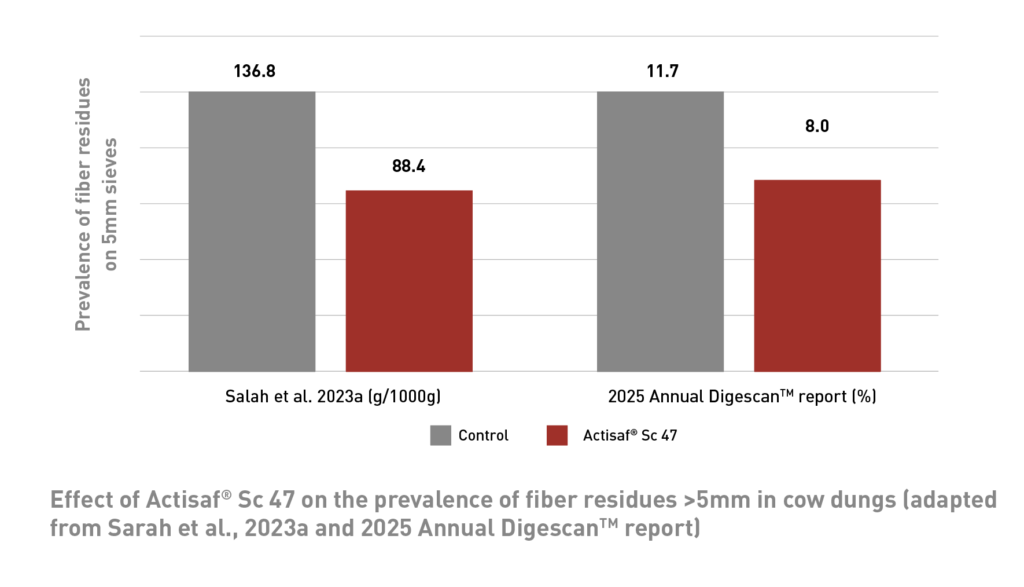
Feed digestion evaluation using dung sieving techniques is a method routinely implemented in the field by Phileo teams and customers through a service called DigescanTM. Data recorded over the 2022-2025 period show a reduction in the prevalence of particles retained on 5 mm sieves from 11.7% to 8.0%, associated with the introduction of Actisaf Sc 47 on farms (2025 DigescanTM annual report, 2026). These results suggest an enhanced feed efficiency following the addition of the yeast probiotic.
Unlocking the full potential of feed into milk
To elucidate more tangibly the impact of Actisaf Sc 47 supplementation on feed efficiency of high-yield dairy cows, a scientific work was recently conducted at the University of Nottingham (Garnsworthy et al., 2025). The PMR feeding system used in this study was representative of current feeding strategies in Europe for intensive dairy farming, with an average NDF content of 29% DM and a crude protein level of 17% DM, based on an average 55:45 DM forage-to-concentrate ratio. Acting on rumen health and function with Actisaf Sc 47 maximized fiber digestibility by 6% and nitrogen digestibility by 2.9% leading to an additional production of 2.7 kg of Energy-Corrected Milk per day without any rise in feed consumption and, importantly, together with a better energy balance of the cows.
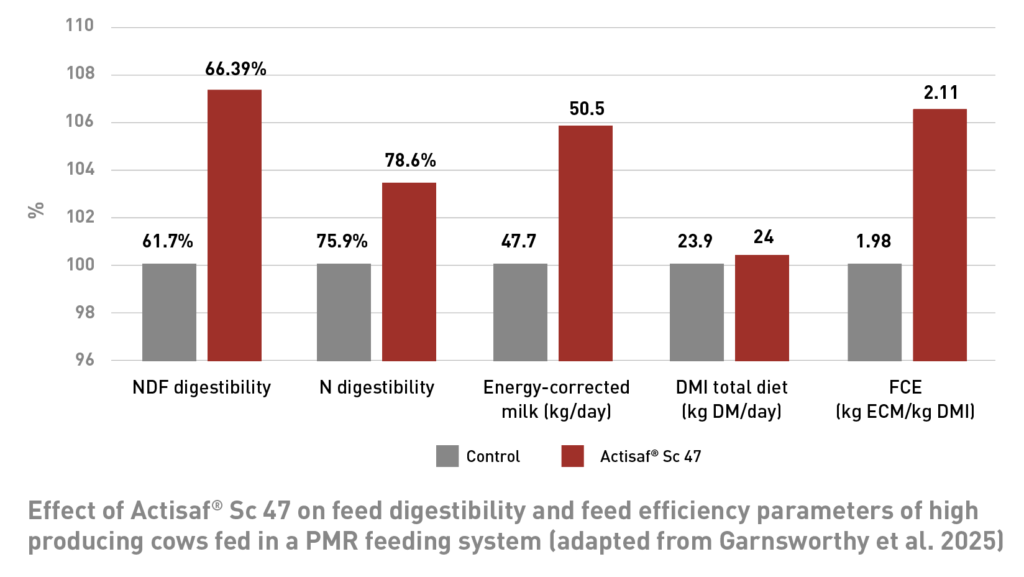
The result was a significant 13-point increase in feed efficiency, meaning 130 extra grams of ECM without any extra feed costs, simply by converting the same amount of feed into more milk. This study underlines Actisaf Sc 47 as a valuable tool to increase milk revenue per kilogram of feed. It also provides an opportunity for nutritionists and producers to optimize feed costs by allowing for an increased proportion of forage in the diet, without compromising performance.
Reliable returns for each spent penny
When every penny counts, feed formulation can only accommodate reliable nutritional solutions. The yeast probiotic Actisaf®Sc 47 fits this bill, with a proven track record of enhancing milk production backed by numerous scientific results.
A recent meta-analysis (Salah et al., 2023b) examined 22 recent trials analysing the impact of the yeast probiotic on the performance of dairy cows under a variety of nutritional conditions and environmental variations. Cows supplemented with Actisaf® Sc 47 produced, on average, an additional 1.72 kg/day of milk and 2.45 kg/day of Energy-Corrected Milk, revealing Actisaf Sc 47 as an effective and trustworthy solution in enhancing milk production in dairy cows and, by extension, sustaining feed efficiency.
Conclusion
In an era of tight margins, dairy producers must focus on optimizing the very foundation of their operations: the rumen. By supporting an effective and resilient rumen microbiota with proven solutions like Actisaf Sc 47, they can build herds that are more effective at transforming feed into milk and at limiting feed wastage, empowering dairy operations to thrive, even when the economic climate is less than ideal.
References
Garnsworthy, P. C. et al. (2025). Effects of live yeast on milk yield, feed efficiency, methane emissions and fertility of high-yielding dairy cows. animal, 19(1), 101379.
Marden, J. P. et al. (2008). How does live yeast differ from sodium bicarbonate to stabilize ruminal pH in high-yielding dairy cows?. Journal of Dairy Science, 91(9), 3528-3535.
Phileo by Lesaffre. (2026). Digescan Annual Report 2025
Pinloche, E. et al. (2013). The effects of a probiotic yeast on the bacterial diversity and population structure in the rumen of cattle. PloS one, 8(7), e67824.
Salah, N. et al. (2023a). Evaluating fecal sieving tool as an indicator of feed valorization and the impact of feeding strategy on dairy cow performance under farm conditions.
Salah, N. et al. (2023b). Meta-analysis study of the effects of yeast probiotic supplementation on milk production and energy corrected milk of lactating dairy cows.
Sorry, the comment form is closed at this time.